


A-Evolve-Training reports four autonomous post-training rounds in which a meta-agent, an agent that revises research procedures, updated the policy used by later workers. In round three, the development score reached 0.93 while the public leaderboard score was 0.85. A collector fetched leaderboard feedback between rounds, and the meta-agent used the discrepancy to redirect search.
The system recognized a misleading development metric and changed its research policy. But the public leaderboard also guided later choices, so it cannot serve as an untouched final test of the policy change.
For a quantitative researcher, the distinction is familiar. Finding a better strategy and improving the procedure that finds strategies are different achievements. To measure self-improvement, we need to follow the changes from the current result into the agent’s later work.
On Thursday, October 1 at 11:00 a.m. Eastern, my Lightning Lesson, Can AI agents improve themselves?, maps the improvement loop onto a forecasting agent and examines how to measure performance changes.
For hands-on practice with an auditable multi-agent architecture, Engineering a Multi-Agent Forecasting System on Saturday, October 3 compares configuration profiles on the same questions.
What gets better?
Self-improvement can reach progressively further into the system producing a result:
The output improves. The system revises an answer, program, or research result. Evaluation compares the original and revised outputs.
The agent improves. It retains changes to its memory, tools, code, or model. Evaluation tests whether those changes help on later tasks.
The improvement process improves. The system revises how it proposes, tests, or selects subsequent changes, then reuses that procedure. Evaluation compares the successors produced by the original and revised procedures under comparable resources.
The experimental standards remain consistent: appropriate controls, protected evaluation, resource accounting, and repeated runs. As the object of improvement expands, the experiment must explain more. A better answer alone cannot show that the agent acquired a reusable skill, or became better at developing skills.
Recursion concerns how a retained change feeds back into subsequent improvement. When an agent revises its improvement procedure, later rounds inherit a different way of producing changes. Reuse establishes that feedback; a controlled comparison tests whether it helps. Acceleration measures progress across cycles, rather than serving as a prerequisite for useful recursive improvement.
How much does the agent control?
Duan and colleagues’ survey, The Last AI Built by Humans, organizes recursive self-improvement around five levels of autonomy. L1 covers executing prescribed improvements, and L2 covers selecting improvement strategies. L3 chooses what experience to learn from, and L4 adapts through deployment feedback. L5 changes the mechanisms governing subsequent improvement. The survey also separates the ability to modify a procedure from evidence that the modification helps under comparable budgets and independent evaluation.
The autonomy levels describe which decisions a system controls. The improvement targets above describe what gets better. An agent can control more of its own development without making better decisions. Both its responsibilities and its measured performance need to be described.
Improving the output
Self-Refine illustrates the simplest case. A model drafts an answer, critiques it, and revises it. The paper reports improvements across seven tasks without additional training. A later task need not inherit any change to the system that produced the revised answer.
Consider a hypothetical factor-research agent that tests 50 variants and selects one. A higher independently validated score for that factor measures an improvement in the output. It leaves open whether the agent will perform better in its next research campaign.
Improving the agent
A lasting improvement requires a change that survives the current task and helps in later work. The change may reside outside the model’s weights.
Reflexion retains linguistic reflections in episodic memory and retrieves them during later trials. Its model weights stay fixed, while the retained reflections can change later behavior. To assess persistent improvement, compare performance with and without those reflections under comparable resources.
RSIAgent makes memory reuse explicit. Its exploration phase writes memory from practice and verification. The reference evaluation resets the environment, freezes the memory, and disables curriculum decisions and memory writeback. The official evaluator’s feedback stays outside the learning agents.
Freezing memory separates learning from evaluation-time reuse. It does not by itself establish transfer to unseen tasks. RSIAgent’s target-conditioned exploration can practice on the target itself. The retained memory also leaves the underlying model and memory-learning mechanism fixed.
To track the agent’s development, identify its mutable boundary: the components it can edit. Record persistence, whether a change survives, and inheritance, whether a later process uses it. Each retained artifact needs a version and a record of the processes that loaded it. The model, evaluator, and selection rules should also be identified, including which remain fixed.
Suppose the factor agent also writes a revised search policy. Loading that policy in the next campaign establishes inheritance. Whether it improves the campaign remains an experimental question.
Isolating the contribution of a retained change
Causal attribution concerns what caused the improvement. Transfer tests where it holds. Evaluator independence requires keeping the final test outside the feedback used during selection.
For the factor agent, compare the original and revised policies using the same model, data access, and candidate budget. Give both access to the accumulated research archive. Otherwise, the revised policy may benefit from knowing which ideas already failed while the original policy repeats them.
An ablation removes a candidate cause while keeping the rest of the experiment comparable. A memory ablation might remove retained reflections or replace them with irrelevant ones. A policy ablation restores the earlier procedure. State what each comparison isolates.
Resources belong in the comparison. RE-Bench, which evaluates AI research and engineering work, compares performance at different time budgets. Equal iteration counts can hide differences in token use, tool calls, or human assistance. For a research agent, count candidate strategies and backtests as well as model expenditure. Report the cost of producing inherited state separately from the cost of using it.
Repeat each condition and report uncertainty across runs. Shared tasks and paired seeds can reduce comparison noise, but repeated runs do not replace evaluation on new tasks. Preserve failed candidates and rejected updates; reporting only the winning run hides how much search produced it.
Transfer asks whether the retained change helps beyond its selection setting. That might mean new tasks from the same distribution, another domain, or a later market period. A later random seed tests repeatability under stochastic variation, not cross-domain transfer.
RRSI, by Peng Xia and colleagues, supplies a concrete transfer test. It evolves an agent’s harness, the prompts, tools, and control logic around a frozen model. The method limits proposed edits, screens benchmark-specific changes, and prunes changes with insufficient benefit. In its workspace ablation, unregularized evolution scores 92.8 on the optimization set versus RRSI’s 90.5. Their average scores on three unseen benchmarks are 40.3 and 43.6, respectively. RRSI uses fewer policy tokens than unregularized evolution, but more than the starting harness. The result supports transfer from a designer-specified improvement procedure; it does not establish that the system autonomously improved that procedure.
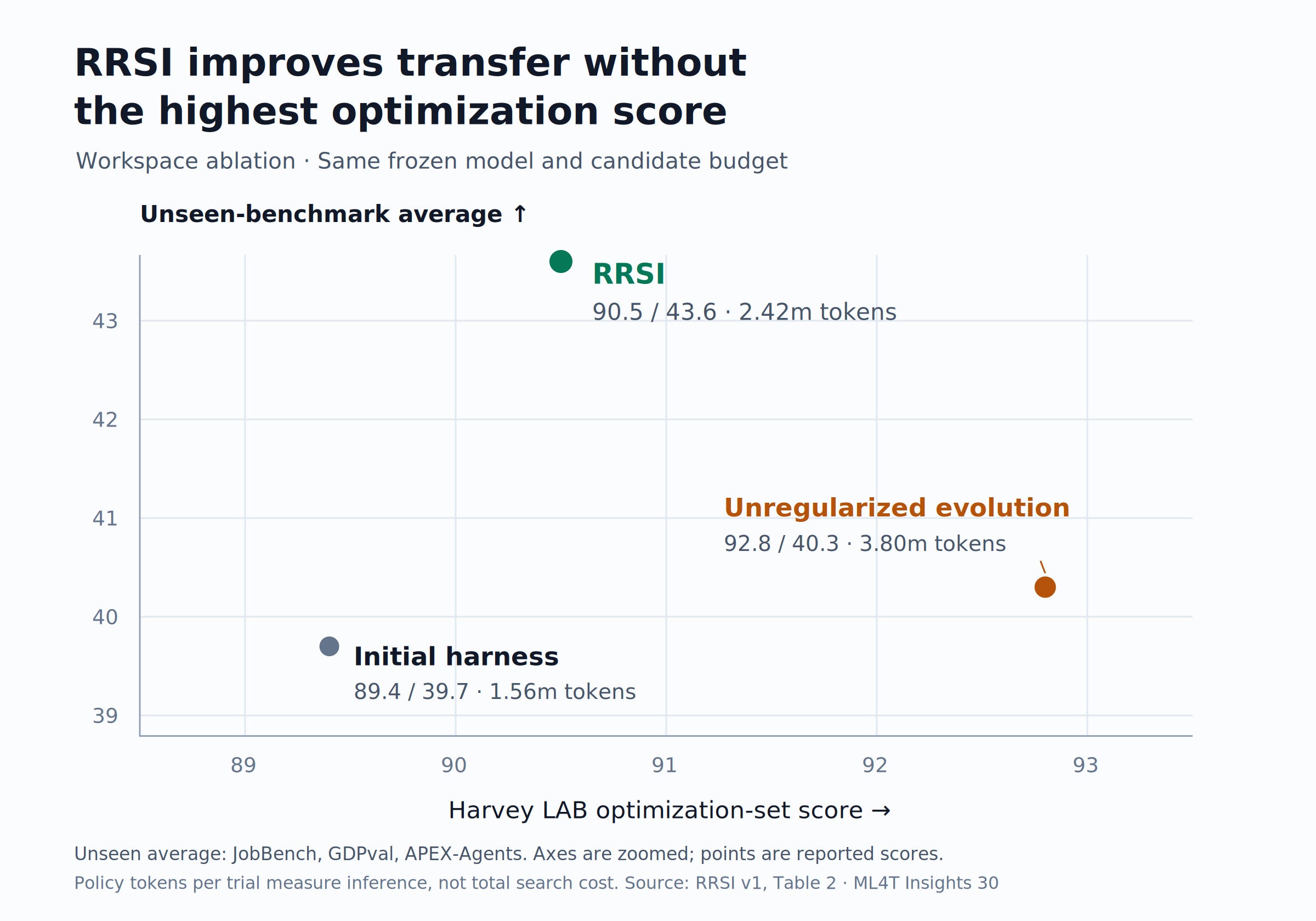
RRSI trades a lower optimization-set score for better results on unseen benchmarks. Token counts measure inference per trial, not the full search budget. Source: RRSI v1, Table 2.
For the factor agent, select the policy on development data, freeze it, and compare policies on a later period. Record whether performance persists across instruments or market conditions. A gain confined to one regime leaves its usefulness in other regimes untested.
The final test must also remain outside the feedback used to select the policy. If an agent repeatedly queries a nominal test grader and adapts to its scores, the grader participates in development. Indirect feedback through a verifier or a human selector can create the same problem.
Anthropic’s Automated Weak-to-Strong Researcher provides a documented example. Nine agents worked for five days with unlimited submissions to an outcome grader. Anthropic reports that this effectively turned the test set into a validation set. Agents exploited the access through seed selection and, in one case, probing uncertain examples with both labels.
A sealed final benchmark or prospective outcomes can limit that exposure. An independent review team helps only if its evidence and feedback are protected too. Changing the people who score a reused dataset does not restore its independence. Record who could query each evaluator, what feedback they received, and when selection stopped.
Improving the improvement process
Meta-improvement means improving the procedure that produces later changes. An agent might revise its experiment-selection rule, then use that rule to direct subsequent research. Measuring the effect requires comparing the research produced by the original and revised procedures.
One strong design compares three conditions under matched resources:
The original procedure with its original evidence.
The revised procedure with accumulated evidence.
The original procedure with that same accumulated evidence.
The third condition helps separate a procedural improvement from access to a better archive. For the factor agent, it asks whether a new experiment-selection rule helps after both policies know which factors were already tried. Other controlled interventions can isolate the same effect.
Hyperagents tests a changed improvement procedure directly. Its transfer experiment freezes evolved meta-agents and lets them generate agents for Olympiad math grading. After 50 iterations, the reported imp@50, the test-score gain of the best validation-selected descendant over its starting agent, is 0.630 (confidence interval 0.540-0.630). The initial-meta-agent comparison has a gain of zero. This supports transfer of improvement ability under the experiment’s fixed iteration budget.
A separate 200-iteration experiment allows the meta-agent to keep evolving. Starting from transferred agents yields 0.640 versus 0.610 from the initial agent, a difference the authors report as statistically insignificant. These are different protocols, not successive observations on one learning curve. Faster learning after transfer does not by itself establish a sustained increase in the rate of improvement across cycles.
A-Evolve’s inherited policy bundles a standing hyperparameter recipe with search instructions. Its baseline worker controls noise against a fixed training substrate, but does not isolate the effect of the revised policy given the same accumulated evidence. The reported four-round campaign supports policy inheritance and adaptive search; attributing its gains specifically to meta-improvement needs a further controlled comparison.
Measuring acceleration
A better improvement procedure can yield a one-time gain or continuing gains that diminish as the remaining problems get harder. Recursion describes the feedback into later improvement; acceleration measures whether progress per unit of resources increases across cycles.
Measuring acceleration requires a sequence of comparable cycles, with each cycle’s gain related to its resource use. Specify the performance measure and resource unit before interpreting the trend. Report raw scores alongside normalized gains, and account for changes in models, tools, task difficulty, and human intervention.
The measurement scale also matters. Bounded scores leave less headroom as performance rises. Transforming the scale can change the apparent curvature, so a headroom or log-odds transformation needs justification. Neither a flattening score curve nor a favorable transformation alone settles whether the improvement process is accelerating.
The experiments discussed here support different forms of retained improvement and procedure transfer. They do not establish a sustained increase in resource-adjusted improvement rate across comparable recursive cycles.
Comparing the experiments
Self-Refine
Retained change: None required across tasks.
Demonstrated result: Better current outputs.
Remaining question: Does a later task benefit from retained state?RSIAgent
Retained change: Frozen exploration memory.
Demonstrated result: Later execution uses learned memory.
Remaining question: What transfers beyond target-conditioned practice?RRSI
Retained change: Agent harness.
Demonstrated result: Gains on unseen benchmarks.
Remaining question: Does the improvement procedure itself improve?Hyperagents
Retained change: Task-agent and meta-agent code.
Demonstrated result: Procedure transfer at a fixed iteration budget.
Remaining question: Does improvement per resource unit accelerate?A-Evolve-Training
Retained change: Recipe and search policy.
Demonstrated result: Inherited policy revision.
Remaining question: Does the revised procedure help under matched evidence?
The comparison summarizes the specific experiments described above. It does not assign a general capability level to each system.
What to report
Before optimization, specify whether the experiment measures changes in the output, the agent, or its improvement process. Define the performance measure, fixed components, resource budget, and protected final test. A useful run record covers:
Mutable boundary: what could change, what stayed fixed, and who could intervene.
Persistence: the retained artifacts and when each was frozen.
Inheritance: the later runs that loaded those artifacts and the decisions they affected.
Causal attribution: ablations, resources by condition, repeated runs, and uncertainty estimates.
Transfer: tasks, domains, or periods excluded from selecting the change, with results reported separately.
Evaluator independence: all feedback available during search, query counts, access controls, and the final evaluation procedure.
Meta-improvement: the comparison isolating the revised procedure from accumulated evidence and extra resources.
Progress across cycles: scores, resource use, and inherited changes, including unsuccessful updates. A study of acceleration also compares the rate of improvement across those cycles.
A study of output quality need not demonstrate meta-improvement. Reporting which parts of the system were evaluated keeps a useful result interpretable without implying that every part improved.
Measure a forecasting agent
On Thursday, October 1 at 11:00 a.m. Eastern, my Lightning Lesson, Can AI agents improve themselves?, maps the improvement loop onto a forecasting agent and examines how to measure changes in its performance and research process.
For hands-on practice with an auditable multi-agent architecture, Engineering a Multi-Agent Forecasting System on Saturday, October 3 compares configuration profiles on the same questions. You will toggle the supervisor, change aggregation methods, and examine Brier scores and calibration on resolved questions.