


Bridgewater’s applied AI team published a talk on the Pocket Analyst Tool (PAT), a research analyst deployed internally to hundreds of their investors for several months. Brendan McManus, Michael Ran, and Santi Weight spent 25 minutes on how it is built, with architecture diagrams and accuracy numbers. Most of what they describe is not about models.
McManus sets the scope before the demo runs:
PAT is not about how we trade. It’s really about performing deep exploratory research, enabling our investors to go after questions that they never would have had the bandwidth to pursue before.
Asked in the comments what the return has been, Weight replied that exact numbers are hard, then named time saved on analyses, “expected multiple man-years in first few months”, and investors trying things they would otherwise have dropped, which he marks as value-add rather than efficiency gain.
Their roadmap is a set of discrete sub-agents covering a research cycle: perceiving what is happening, forming questions, investigating, synthesizing, and folding what was learned back into shared memory. PAT is the investigation piece. Its outputs land in the same database its inputs came from, so one analysis becomes an input to the next, and human and agent work accumulate in one place.
The AIA lab has also published the AIA Forecaster. On Saturday, August 1, I introduce agent engineering by demonstrating how to design and build this multi-agent forecasting architecture end-to-end for production deployment.
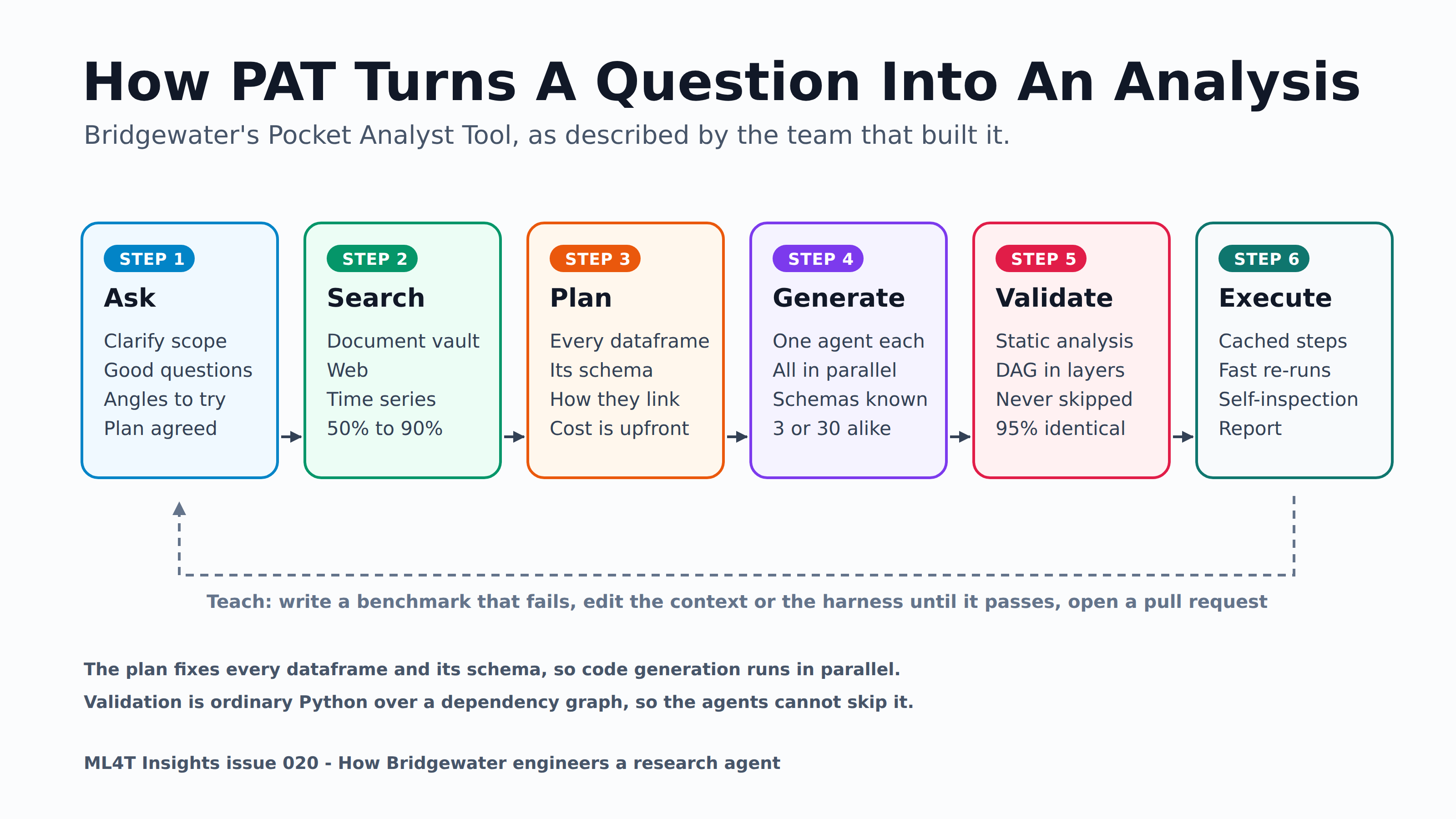
PAT’s pipeline: clarify, plan, generate, analyze dependencies, execute, validate, with a Teach loop feeding corrections back into context and harness
Domain inspection took retrieval from 50% to 90%
PAT searches a time series database holding tens of millions of series, some external like the price of oil, some internal like their own 12-month-forward inflation estimate. The search agent starts with what you would expect. Ran:
The search agents use traditional search techniques like RAG, re-ranking, et cetera, but the thing we found to be a huge difference-maker was layering on an element of human-like inspection.
The inspection is what a researcher does without narrating it. You do not accept a series because its name matched. You look at the frequency, you look at the currency, and you check whether the values agree with what you already believe about the world.
So embedding this sort of reasoning into our search agent is something that got us up from roughly 50% accuracy all the way to 90%.
Fifty to ninety, from encoding domain judgment as search logic. Both numbers are Bridgewater’s own; in the evaluation, the talk does not describe how many queries, what counted as correct, or whether the two measurements share a test set. The direction is the transferable part. The reflex when retrieval underperforms is to reach for a better embedding model or a reranker. Their gain came from writing down what an analyst checks before trusting a series.
The dataframe plan is an intermediate representation
PAT resolves ambiguity with the user first, then plans. The planning phase names every dataframe the analysis will produce, the schema of each one, and how they connect. Ran calls the cost deliberate, and it buys something specific.
Because every task declares its output schema up front, code generation for all of them runs in parallel. A visualization task at the end of the plan already knows the shape of data produced by a loading task whose code does not exist yet.
So this lets an analysis with three data frames or a medium-sized one with something like 30 data frames take roughly the same amount of time to generate code in both scenarios.
Their benchmark names its comparison. For the same context and the same plan, PAT generates code about four times faster than Claude Code, and a 20-task plan costs what a three-task plan costs.
The structure has a published analog. LLMCompiler (Kim et al., ICML 2024) plans a directed acyclic graph of tasks with their dependencies and dispatches them to a parallel executor, reporting up to 3.7x lower latency and roughly 9% better accuracy than ReAct on its benchmarks. LLMCompiler’s graph is over function calls. Bridgewater’s is over dataframe schemas, which makes the plan a domain-specific intermediate representation: code generation lowers it into Python, and the unit being compiled is an entire analysis. What the schema buys is that downstream work can start before upstream implementations exist.
Weight pushes the framing further. The plan is a natural language Python project, not the to-do list a coding agent keeps, and two agents compiling the same task should produce code that computes the same values.
Validation is mandatory, not discretionary
Weight’s background is compiler theory. A compiler lowers user code to something executable, and it treats determinism and correctness as requirements rather than aspirations. A coding agent lowers a plan to Python. He argues for building the second the way the industry already knows how to build the first.
Concretely: after generation, static analysis builds the dependency graph, and validation agents run in parallel across its layers. A five-task plan collapses to three layers, a twenty-task plan to four or five. The orchestration is ordinary Python.
The main point I want you to take away from this part of the slides is that we enforce correctness in the architecture. Again, no agentic orchestration. This is regular Python code, so the guardrails are really hard, and the agents cannot forget to validate. They are forced to validate.
Their phrasing is worth reading narrowly, because the narrow version is the useful one. Ordinary Python control flow guarantees that every generated task passes through the prescribed validation stages, which removes the failure mode of an agent deciding this particular output does not need checking. It guarantees nothing about whether the validators test the right properties, whether the expected values are right, or whether a task and its validator share a common-mode error. The architecture makes validation happen; whether the validation is sufficient is a question for the test suite.
There is evidence behind putting the check outside the agent’s discretion. Huang et al. (ICLR 2024) tested intrinsic self-correction, where a model revises its own answer using nothing but its own judgment, and found that reasoning performance fails to improve and, in their experiments, frequently degrades. They frame that setting as the one that matters in practice, since high-quality external feedback is often unavailable. PAT does inspect its own output, which Ran compares to a junior analyst double-checking work before handing it over, and that inspection at least has computed values and rendered charts to work against. The paper’s finding applies to the case the architecture removes: judgment as the only check.
The result:
The result is that when we run our test suite on any plan, 95% of the time, the code that comes out is exactly the same for two different agents. So it’s essentially a deterministic coding agent.
“Exactly the same” is doing unexamined work here. Identical source, identical computed values, and semantically equivalent code are three different claims, and the talk names neither which one it measured nor how large the suite is. Read as high reproducibility on their internal suite, it still buys something. Evaluation survives nondeterminism; it just costs more runs: when two runs of the same plan can disagree, attributing a change to your prompt means averaging over enough runs to separate the effect from generation variance. Their phrase for the alternative is “vibes-based or LLM-as-judge evals.”
That aside is fairer to judges than it reads. Zheng et al. (2023), the work that popularized the method, report agreement with human preferences above 80% and document in the same paper that judges exhibit position bias, verbosity bias, and self-enhancement bias, the last being a model’s preference for its own output. Where a property can be checked by an executable test, the test is the more direct instrument. Open-ended qualities still need a judge, with that drift priced in.
Incremental execution on a runtime they own
PAT does not invoke its own generated code through a terminal. Bridgewater runs it for the model, injecting caching annotations by static analysis so intermediates are never recomputed. Their second benchmark takes the last chart in a plan and changes its name. Claude Code reruns the lot; PAT re-executes essentially instantly. Small edits to a finished analysis stop carrying the cost of a full iteration, so an investor can keep adjusting one while still thinking about it.
This is available to Bridgewater because they own the execution environment. An agent shelling out to a terminal cannot inject caching into a runtime it does not control, which is the same point as treating the harness as context plus tools.
The transferable idea is incremental execution over an explicit dependency graph, and it arrives with the problem every build system has. A renamed chart is the easy case. The graph tells you what to recompute only if the cache key captures code changes, data versions, parameters, and the relevant environment; get invalidation wrong and stale intermediates survive an edit that should have killed them.
Observed failures become regression benchmarks
A user who thinks PAT should have done better presses a Teach button, and an agent reads the conversation for behavioral mistakes, context gaps, or steering that could have been anticipated. Then, in order: it writes a benchmark expected to fail, confirming the bad behavior reproduces. It edits the context repositories or the harness until that benchmark passes. It verifies the rest of the suite still passes, so the fix cannot silently break an earlier one. It opens a pull request, which arrives in Slack for a human.
This is test-driven development pointed at agent behavior. Writing the failing test first is what ties the change to the behavior a user actually reported. Who defines the expected behavior decides whether the loop is worth anything, because a conversation can reveal a user’s preference as readily as an objective error. The human holds that step twice: the user can revise the proposed lesson before it becomes a benchmark, and a reviewer decides whether the pull request changes PAT for everyone. Agents also mine completed conversations for the same material without being asked, and a correction reaches every investor at the firm rather than only the one who hit the problem.
One PAT per investor, differing by context and tools
Different investors at Bridgewater see different things. Someone with access to firm positions needs a PAT that knows them; an analyst without that access needs a PAT that cannot leak them. Ran describes the resolution in one line:
Practically speaking, this uniqueness is just a function of what context and what tools each person’s PAT has.
Every investor runs their own PAT, and the difference between any two is which context is loaded and which tools are exposed. That is a clean account of personalization, and it is not a security boundary. The data and tool layers still have to enforce each investor’s permissions, because a context-assembly rule that is too broad, or a tool that reaches further than intended, exposes data whether or not the model was told to respect the limit.
What the team says it learned
Weight leaves the audience with three things: specialize agents instead of building generic, powerful ones; benchmark narrow workflows heavily and hill climb them; and treat agentic coding as a compiler problem. The first comes with a warning.
We don’t really believe in generic, powerful agents. They make really cool demos. I’m sure many of us have given them. But it’s really hard to make that a daily workflow that you can depend on.
What does not carry over
Bridgewater has been writing down the causal logic behind every trade since a 1980 bond system on a yellow legal pad, and codifying it into machine-readable form ever since. McManus is direct about the advantage:
We didn’t have to go back and write down everything for agents. It was already there for us to draw upon.
Fifty years of codified investment logic, tens of millions of modeled series, and millions of documents arriving at thousands a day. Few teams can reproduce that, and the talk says plainly that it is the foundation the rest sits on. The second advantage is how the work is staffed. McManus describes multi-archetype teams with investors, technologists and scientists sitting side by side: “Investors bring the context and the domain-specific expertise. Technologists bring the architectural capability. And scientists bring the rigor.”
Five things carry over without a hedge fund’s archive: encoding domain inspection into retrieval, planning in enough detail that generation parallelizes, enforcing validation structurally so it cannot be skipped, converting observed mistakes into failing benchmarks, and treating the harness as context plus tools. Each still needs schemas, metadata, and access rules of your own, which is real work. None of them needs fifty years of it.
The unanswered point-in-time test
The highest-rated comment on the talk proposes a test: reconstruct a past thesis “using only information available on that date,” which would “separate fluent retrieval from genuine research discipline.” That is point-in-time correctness, and it decides whether a research system is measuring anything at all. Nothing in the talk says how PAT handles it.
The same firm’s AIA Labs has published on exactly that problem for a different system. The AIA Forecaster technical report treats foreknowledge bias, information reaching the model from past its intended cutoff, as a first-class evaluation target. They built an LLM judge that flags search results implying knowledge beyond the cutoff, hand-audited 502 sampled traces to calibrate it, and estimate that about 1.65% of search results carry some leakage. Bounding the worst case moves their headline Brier score from 0.1159 to 0.1166. They also built MarketNightly, a live benchmark drawing only on active prediction markets, where foreknowledge is impossible by construction rather than merely detected.
The forecasting results are worth stating precisely, because the direction changes with the benchmark. On ForecastBench, the AIA Forecaster is statistically indistinguishable from expert superforecasters, scoring 0.1076 against their 0.1110 on one variant and 0.1099 against 0.1152 on the other, where lower is better. On MarketLiquid, a harder benchmark sourced from liquid prediction markets, it trails the market consensus, 0.1258 against 0.1106; a regression ensemble of the two reaches 0.106 and beats both. Matching superforecasters on one benchmark and losing to a liquid market on a harder one both appear in the same paper. That is the standard of reporting to want before believing an agent result.
On Saturday, August 1, I teach this architecture by building it: a forecasting agent end-to-end, working from my own implementation of the AIA Forecaster above. Prompt, context, harness, loop. Typed tool contracts, agent state and replay, point-in-time research agents running in parallel, a supervisor that reconciles their disagreement, and evaluation with proper scoring. 10:00 am to 3:30 pm ET, live. Details and registration.